China has become a major manufacturing base for industrial motion components, including hydraulic and electro-hydraulic rotary systems. This article examines China’s top HKS Rotary Actuator manufacturers and suppliers through practical, technical, and purchasing-focused criteria. Quality matters.
Market research supports this growing interest. Mordor Intelligence’s Hydraulic Actuators Market report identifies Asia-Pacific as a leading regional market, supported by construction equipment, automation, marine systems, and energy projects. Grand View Research also highlights rising demand for compact actuators, improved control accuracy, and reduced maintenance requirements. However, published estimates differ because researchers use different product definitions and regional data. That limitation deserves attention.
A reliable supplier should provide more than a catalogue photograph. Buyers should verify torque ratings, allowable radial loads, rotation angles, pressure limits, sealing materials, and fatigue-test results. ISO 9001 certification can support process consistency, but it does not automatically prove actuator performance. Request test records.
Factory experience is equally important. A capable Chinese manufacturer should explain machining tolerances, heat-treatment procedures, seal selection, and final inspection methods. It should also provide traceable drawings, installation guidance, and responsive after-sales support. In real applications, a small leakage problem can stop a production line, damage nearby components, or create costly downtime.
This guide compares supplier capability, engineering depth, customization options, delivery reliability, and export experience. It also considers whether each company can support prototypes and repeat orders. The strongest option is not always the cheapest one. Sometimes, the lowest quotation hides weaker testing or unclear specifications. Careful verification remains essential.
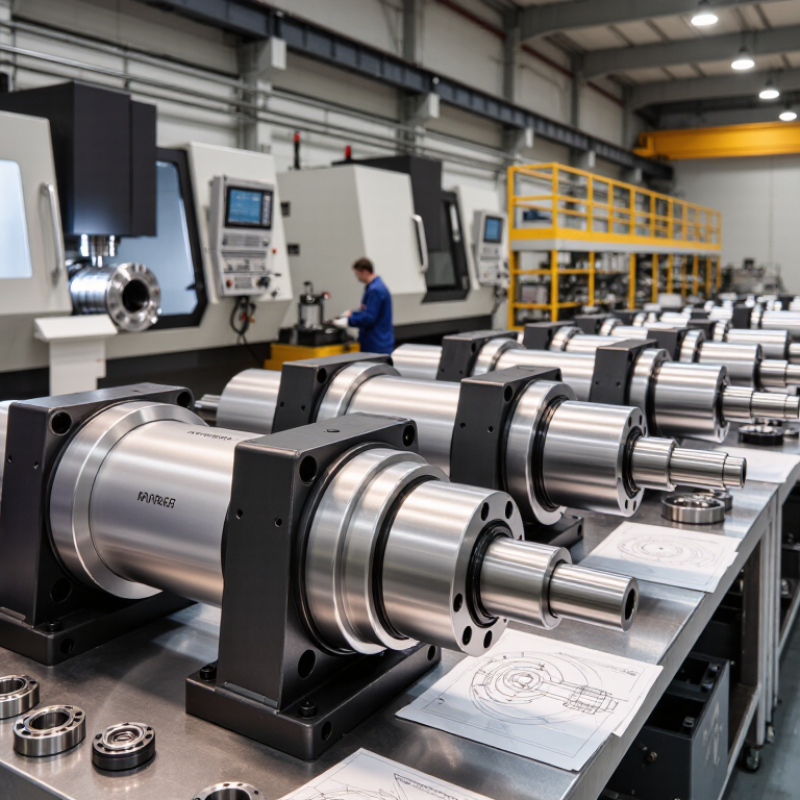
Rotary actuators convert compressed air or hydraulic pressure into controlled angular motion. Rack-and-pinion designs suit common 90° and 180° movements. Vane designs offer compact construction and smooth positioning. Scotch-yoke mechanisms can deliver higher torque near the end of a stroke. Selection depends on load, speed, space, and operating environment.
Torque output changes throughout the rotation. A published torque figure may represent starting torque, running torque, or theoretical torque. These values are not interchangeable. I have found that starting torque is often underestimated when valves, dampers, or seized linkages are involved. Add a practical safety margin, but avoid excessive oversizing. Large actuators can move slowly and waste energy.
For 90° service, confirm the exact end stops and mounting pattern. Applications requiring 180° or 360° rotation need suitable shaft design and control feedback. Continuous rotation is not automatically available. Suppliers should provide torque curves, seal materials, cycle-life data, and test records. Ask how performance changes under low pressure and temperature variation. A supplier may quote an attractive number, yet omit friction losses. That deserves a second look. Reliable manufacturers explain their calculations and help match the actuator to the real load, not only the catalog load.
| Actuator Design Type | Typical Drive Principle | Typical Torque Output | Available Rotation | Typical Operating Pressure or Voltage | Common Speed Range | Typical Applications |
|---|---|---|---|---|---|---|
| Pneumatic rack-and-pinion | Compressed air drives a piston and rack connected to a pinion | 5–4,000 N·m | 90°, 120°, 180°, or adjustable up to 360° | 2–8 bar typical | 0.1–3 seconds per 90° cycle, depending on size and load | Valve automation, material handling, packaging, and process equipment |
| Pneumatic vane type | Compressed air acts on one or more rotary vanes inside a housing | 0.2–250 N·m | 30°–270°, with some designs supporting up to 360° | 2–8 bar typical | High-speed short-stroke rotation; commonly below 1 second per cycle | Clamping, indexing, small dampers, and compact automation systems |
| Electric gear-driven rotary actuator | Electric motor combined with reduction gears and a rotary output shaft | 2–5,000 N·m | 90°–360° or continuous rotation, depending on control system | 12–48 VDC or 110–480 VAC | 0.1–60 rpm typical for geared output | Dampers, conveyors, positioning equipment, and automated valves |
| Electric quarter-turn actuator | Motor and gearbox provide controlled quarter-turn movement | 10–4,000 N·m | 90° standard; adjustable travel is available on selected models | 12–48 VDC or 100–240 VAC typical | 10–120 seconds per 90° cycle | Ball valves, butterfly valves, HVAC dampers, and water-treatment systems |
| Hydraulic rotary actuator | Pressurized hydraulic fluid produces rotary motion through a vane, piston, or helical mechanism | 500–500,000 N·m | 90°–360°; multi-turn designs are also available | 100–350 bar typical | 0.5–60 rpm, depending on flow rate and displacement | Construction machinery, steel equipment, marine systems, and heavy-duty handling |
| Servo rotary actuator | Servo motor with feedback encoder and precision reduction mechanism | 0.1–2,000 N·m | 90°–360°, multi-turn, or continuous rotation | 24–400 VAC/DC, depending on motor size | 1–3,000 rpm at the motor; lower at the geared output | Robotics, indexing tables, CNC equipment, and precision assembly |
| Electro-hydraulic rotary actuator | Electric control system regulates hydraulic power for high-force rotary motion | 1,000–100,000 N·m | 90°–360° or application-specific angular travel | Typically 100–315 bar hydraulic pressure | 0.1–30 rpm, with speed controlled by the hydraulic circuit | Heavy industrial automation, offshore equipment, presses, and test systems |
| Compact rotary actuator | Miniature pneumatic or electric mechanism designed for limited installation space | 0.05–30 N·m | 90°–180°, with selected designs offering up to 360° | 3–6 bar pneumatic or 12–24 VDC electric | 0.1–2 seconds per cycle, depending on load and control method | Small grippers, inspection equipment, laboratory automation, and compact machinery |
| Note: Torque, speed, pressure, voltage, and rotation values are typical engineering ranges for general rotary actuator categories. Actual performance depends on actuator size, supply conditions, duty cycle, load inertia, mounting arrangement, control method, temperature, and safety factor. Manufacturer selection should be based on the required breakaway torque, running torque, allowable cycle frequency, rotation angle, and environmental conditions. | ||||||
Many applications operate between 70 and 350 bar. Choose pressure for the actual load, speed, and duty cycle. Higher pressure is not always better.
Torque depends on pressure difference, displacement, and mechanical efficiency. A 100 cm³ actuator at 200 bar produces about 318 Nm theoretically. Actual torque will be lower.
Speed depends on flow rate and displacement. A 100 cm³ actuator supplied with 20 L/min reaches roughly 200 rpm. Leakage may reduce the real speed.
Request pressure-flow curves, starting torque, thermal limits, rated pressure, and peak pressure. Ask for shaft-load and backlash data. Maximum pressure alone is incomplete.
Test hundreds or thousands of cycles under changing loads. Check shaft return position after heating and cooling. Three successful demonstrations are not enough.
Request certification scope, calibration records, inspection plans, and recent production samples. Review batch reports and traceability labels. Visit test benches if possible.
Good support may include mounting changes, shaft adjustments, seals, sensors, drawings, and tolerance data. Prototype testing should come before mass production. A printed housing name is not OEM support.
Clean hydraulic fluid, correct alignment, and suitable filtration protect seals and bearings. Inspect behavior during cold starts and sudden stops. Small installation errors can cause early failure.
Compare torque, efficiency, repeatability, pressure, speed, and service intervals together. Ask for endurance results at your operating conditions. I may be too cautious, but polished brochures are not enough.
Rising oil temperature can reduce performance. Marginal filtration may increase leakage and wear. Poor packing can cause transit damage. Clear specifications reduce these avoidable surprises.
Choosing the right Hks Rotary Actuator requires a clear understanding of design, performance, and supplier capability. This guide explains common actuator configurations, torque output, and rotation ranges from 90° to 360°, helping buyers match mechanical movement with application demands. It also reviews hydraulic requirements, including operating pressures of 70–350 bar, speed control, flow needs, and heat management for reliable operation.
The article further compares China-based suppliers by ISO 9001 certification, production capacity, OEM flexibility, torque efficiency, positioning repeatability, and expected service life. A practical buyer’s checklist covers SAE compatibility, ISO 12100-based safety considerations, inspection and performance testing, warranty terms, spare-part support, and lead times. By evaluating these factors together, buyers can select a dependable Hks Rotary Actuator that balances power, precision, durability, customization, and overall project value.

 Weitai Hydraulic